
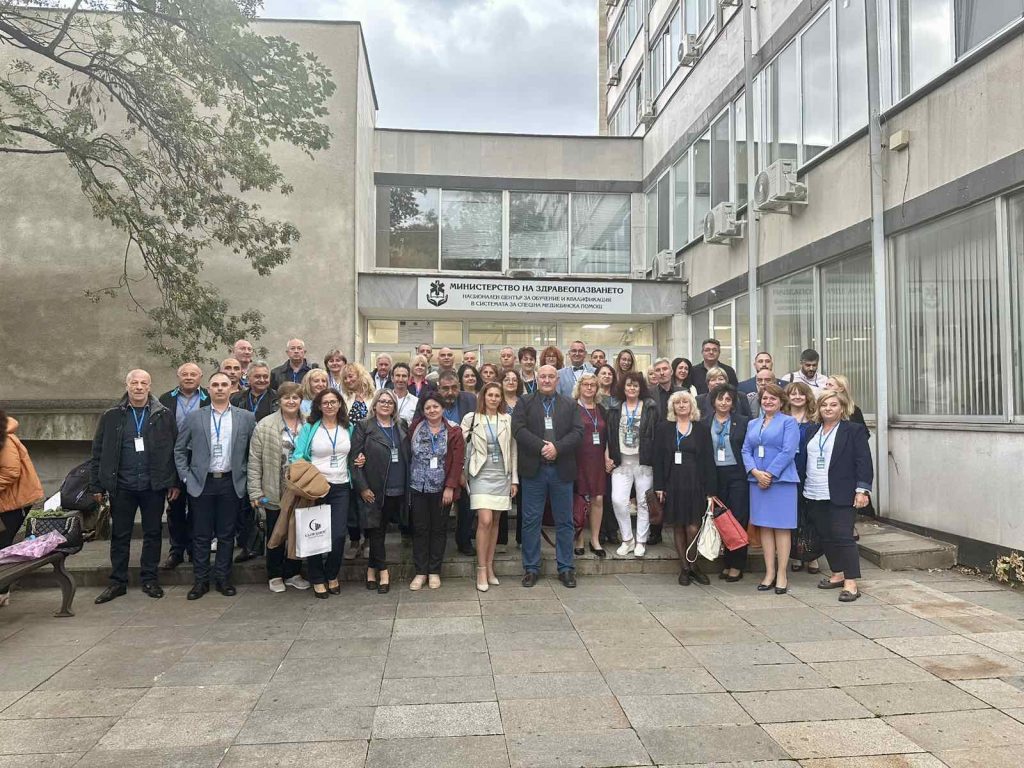
Bulgarian Union of Physician Assistants and Feldshers (BUPAF), is a professional organization within the meaning of the Law on professional organizations of nurses, midwives, associated medical specialists, medical assistants, dental technicians and assistant pharmacists, which protects the rights and interests of medical assistants and feldshers and represents them.
Bulgarian Union of Physician Assistants and Feldshers is a continuation of the objectives, traditions and activities of the Blagodeyenie feldshers society established in 1883, the Union of Medical Feldshers in Bulgaria in 1989, the Association of Medical Feldshers, Bachelors of Medicine in Bulgaria in 2007 and the Bulgarian Union of Medical Assistants and Feldshers in 2020.
In Bulgaria, the profession of ‘Feldsher’ has a 143-year history. The training of feldshers in Bulgaria is the first regulated medical education and dates back to 1879, in response to the need to immediately solve the main medical problem after the Liberation – the problem of cadres. In the early years, when doctors were present in 74 out of 79 towns and only 22 out of 3,849 villages, the time required feldshers to be the providers of medical care to the country's predominantly poor rural population.
Initially established medical and feldshers department health services, in addition to curative, also implement prophylactic activities. Feldshers, in parallel to the examinations, "are obliged to ensure the cleanliness of all public and private establishments, to supervise the benignity of the same and drinking sources, to take measures against the emergence and spread of epidemic diseases. Teach the population about the way of life, the causes of communicable diseases and the means to prevent them.’ Thus, the feldsher was a pioneer in the practice of sanitary service after the Liberation and with the positive results of devotional service to the nascent sanitary work established himself as a necessary professional in all sanitary institutions.
The need for such staff in hospitals is no less significant, since the training of nurses in Bulgaria dates back only to 1900. The established organisation provides that ‘each main hospital shall be managed by a senior doctor, who shall have as assistants one coordinator and three feldshers’. Secondary hospitals are served by a district doctor with the help of one, and less often two, feldshers who are first assistants to the doctors, ‘taking a history of the patients, writing medicine and food sheets to the patients and taking care of them, making bandages, helping with the cuttings (autopsias), on duty in the hospitals and always ready to be of assistance either during the day or at night’.
Historical facts reveal the impressive contribution of feldshers to public health, but despite responsible attitude, professional approach and dedication to work, feldsher have for years been attacked by sanitary administrators and individual doctors. Their professional rights are restricted, unjustifiably feldsher positions on the ground are abolished, jobs are taken away. Their unregulated professional functions in the years of emergence and establishment of the profession, the unfavorable working conditions and the difficult material situation of professionals after the Liberation determine the protection of professional interests as increasingly necessary.
Thus, in 1883, in Sofia (Alexandrovska Hospital), several feldshers and assistant pharmacies set up the first feldsher professional organisation, the ‘Benevolence Society’. The Society is chaired by feldsher Gabriel Genkov. Beneficence existed until 1885, and there is no information about the cessation of activity. In 1887, the company was re-established and approved by the Supreme Medical Council by letter No 63226 of 10.12.1887. The historical feldshers society ‘Blagodeyenie’ is defined as the first professional organisation of medical workers in the country, so the year 1887 is considered the birth of the companies and organisations of medium-sized medical workers in Bulgaria. ‘Medical feldsher in Bulgaria’ is the printing body of the Blagodejenie association, with which professionals receive information on current professional issues, notifications and news about the activities of the staff.
Between the qualified feldshers and the sanitary non-commissioned officers, awarded the rank of feldshers, due to a shortage of personnel, a conflict arose, which was the occasion of a general meeting of feldshers in 1902 to establish two companies. The medical feldsher magazine, published twice a month, and the medical non-commissioned officers magazine, became the printing body of the certified feldshers. ‘Feldsher’.
After 1944, and especially after 1950, the foundations were built and a unified healthcare system in Bulgaria was established. The new organization of socialist health care provides an opportunity for the realization of feldshers in all health structures, which determines the increasing number of professionals over the years: 1965 – 4161 feldshers, 1975 – 5479 feldshers; 1980 – 7 355 feldshers in the health system.
Feldshers provide the settlements with up to 800 inhabitants with curative and prophylactic care, either alone or in a team with a nurse. Actively participate in the policy of conducting a complete and universal dispensary of the population: organize and participate in the implementation of mass prophylactic examinations and summarizing the results of the surveys, in the distribution of the contingents by groups, the technical shaping of the documentation and the referral of the patients for consultation and clarification of the health status. They help prevent and treat traumatic and other illnesses during Polish work in response to the policy of bringing health care closer to the rural worker.
Sanitary feldshers under the supervision of sanitary doctors carry out supervision and audits of small food enterprises, cultural and household establishments, food shops, public canteens and other sites. The professionals working in the sanitary-epidemiological sphere, as assistants to the sanitary doctors and epidemiologists, receive wide rights in the work on the sanitary-supervisory functions performed by them.
The largest number of feldshers is in the ambulance service, where they have been part of the teams - resuscitation and pre-medical since the creation of the special service in 1948. The specific competence of professionals, allowing them to make independent decisions, makes them suitable for work in school health care, various departmental health services, the system of the Ministry of Interior, prisons, rescue services and others.
Despite the widespread implementation of feldshers in the healthcare system, a number of challenges have arisen in the more recent history of the profession of feldsher. They are caused by a frequent change in the educational and qualification degree, limited and late provided opportunities for continuing education, specialization and career development, the need for regulatory regulation of specific competencies.
This prompted an initiative committee of feldshers practising in the then Smolyan District to establish in 1989 in the town of Smolyan, on a municipal basis, the first feldshers union after 1944. The aim of the union was a national union of feldshers, protection of professional interests and contribution to public health.
In 1990, the union was officially registered as the ‘Union of feldshers in Bulgaria’ and effectively succeeded the ‘Federshers’ Society of Blagodenie’ from 1884. The chairman was elected by the feldsher Dimitar Ishkiteev, who was one of the permanent members of the Supreme Medical Council of the Ministry of Health. Already in the summer of the same 1990, the leadership of the Union held a meeting with the Minister of Health Prof. Dr. Chernozemsky to settle the status and functions of feldshers.
Under the guidance of medical feldsher Ishkitiev, many meetings were held with ministers and MPs concerned with the profession and the activities of the staff. The Union has partnered and interacted with the trade unions CITUB and Support, holding successful workshops with them.
In 2000, at the General Assembly in Haskovo, following an internal coup organised by the coordinators of the then Plovdiv District, a decision was taken to suspend the organisation’s activities.
From 2000 to 2007, the organization of feldshers did not report any activity, which had a catastrophic and negative impact on the status, image and existence of the profession.
The discontinued training of feldshers in 1999, together with the organisational changes in health care since 2000, have made the negatives for feldshers more noticeable, especially in terms of employability and professional activity, according to specific qualifications. Workers in the Feldsher Health Services are out of work due to the closure of this type of medical facility. Under the new conditions, the cadres practice in primary care as specialists employed by GPs, often in the same settlements where they worked before the reform. In such practices, the prescription of medicines and the treatment of patients is in many cases carried out by feldshers with the informal powers granted to them. In remote areas of the country there are dozens of settlements where there are no registered medical practices due to their unattractiveness for doctors, and for years in such places feldshers are the only provider of medical care, which under the new conditions they cannot realize due to the fact that they are not employed by GPs.
A challenge and risk for feldshers since the start of the health reform is the work in emergency care, the structure in which they traditionally practice. In the pre-med teams in the ambulance branches, they are responsible for the diagnosis and therapy of patients, but in the absence of a regulation, clear rules and legitimacy of responsibilities at that time. The health reorganisation, with subsequent job losses for feldshers, affected workers and health services at military units and sports dispensaries. The status of the school medical offices has been changed and the activity from curative to prophylactic and promotional, with some professionals experiencing the challenge of being re-assigned to the jobs where the reform has found them. Over the years, positions requiring feldshers qualifications have been reduced and feldshers have been appointed as nurses, performing nursing functions.
Difficulties are grounds for disappointment and professional demotivation, accompanied by the outflow of professionals from the system. Reliability is confirmed by data from the National Statistical Institute, according to which the number of feldshers in the country decreases noticeably outside the natural processes (retirement and death). From 7 617 feldshers working in the system in 1990, the number of feldshers working in the system in ten years was reduced to half – 3 158 in 2000.
In 2007, under the initiative of feldsher Alexander Alexandrov, a seven-member initiative committee revived the professional organization of feldshers. On 23 January 2007, by Decision No 89, the Pernik Regional Court registered an ‘Association of Medical Doctors Bachelors of Medicine in Bulgaria’ (SMFBMB). The association was entered in the register of non-profit legal entities at the Ministry of Justice – Volume V-8, page 530, lot 501, No 20070220009 with Certificate No 009/20.02.2007.
In the spring of the same year, a constituent assembly was held with representatives of the profession from all over the country and a statute was adopted on a democratic principle. In accordance with it, the Association is represented by a Management Board (MB) chaired by Alexander Alexandrov, Deputy Chairman Dimitar Ishkitiev and members Kamelia Vaseva, Galina Bocheva and Marin Valkov. Membership is voluntary and since its inception the feldshers in Bulgaria want their association to acquire the status of a legally legitimate professional organization.
The Board of Directors shall clearly define the objectives of the Association:
- recognition of IMBMB as a nationally representative professional association of feldshers;
- relaunch of the training of feldshers in Bulgaria under the internationally recognised name ‘Medical Assistant’;
- to contribute to the development of healthcare in Bulgaria through opinions on draft normative acts in the field of health;
- with proposals to assist in formulating the legal status of feldshers according to the professional qualification characteristics of the profession;
- to contribute to the professional development, specialization and improvement of feldshers by introducing and introducing modern achievements in the field of medicine;
- to offer opinions to the Ministry of Health, higher medical schools and other institutions in the country on issues and health policies to which feldshers are related to their status and activities, including with regard to the educational and qualification degree of the personnel;
- to make international contacts with similar organizations and implement their experience of good medical practice in accordance with European standards in the activities of feldshers;
- independently or in cooperation with other organisations, to organise and hold forums – conferences, symposia, congresses, etc. – on various medical topics relevant to the activities of feldshers;
- to represent and protect the professional interests of the members of the Association, to assist them and their families in case of need.
Meanwhile, in 2005, the Bulgarian Association of Health Care Professionals (BAHCP) was established as a professional association bringing together the medical professions of the health care professional branch. Feldshers are not satisfied with their destiny under the Law on the Professional Organization of Nurses, Midwives and Associated Medical Specialists (ZSOMSAMS), which determines their mandatory membership as associate members. In practice, with this membership, they do not have an objective professional representation before the state institutions, which actively seeks a solution to the professional problems specific to the profession. Medical model training conferring the right to consultative, diagnostic and therapeutic activity on feldshers defines them as professionals other than ‘nurses’, ‘midwives’ and persons with other professional qualifications whose activity is limited to the implementation of health care.
Officially represented by other specialists, feldshers do not find a solution to problems related to the medical model of personnel activity. This is a reason why over the years professionals have repeatedly expressed dissatisfaction with their formal representation by BAPZG. They are irreconcilable with the public opinion expressed by a leader of BAPZG that the time of the feldshers has passed and as professionals are already obsolete, as they consider it indicative of the attitudes and policy of the management of the organization towards their profession. The Feldshers claim an infringement of their right to equal treatment with other professions in the BFZG, given their status as ‘associated’ in the organisation and their legal disqualification from self-governance and self-regulation – a right to any regulated medical profession, such as the Feldsher profession. ‘With dozens of letters we have referred to the Ministry of Health the forced membership of feldshers/medical assistants in the BAPZG. The Association was established by law, without respecting the democratic right to an opinion on the unification of all the professional classes included in it’, Kamelia Vaseva, a member of the Board of Directors of the UMBMBF, told the media.
The membership of the feldshers in the BAPZG, defined as ‘forced’, was justified by the Board of the feldshers’ association on the basis of the country-wide declarations submitted with a reference number to the Registry of the Health Committee in the National Assembly twice – 2010 and 2014. In them, the professionals declared their personal opinion with the text: ‘my membership of the BAPZG is compulsory under the Professional Organisation of Nurses, Midwives and Associated Medical Specialists Act, but it does not respect my right of personal choice for membership of a professional association, which is in breach of democratic principles. I demand equal treatment with all other medical professionals from regulated medical professions who are members of independent and independent professional associations."
The Board, supported by the members of the Association, actively works to protect the interests of the profession. Organizes three national protests of feldshers in defense of the right to independent professional organization, seeks and uses all legal forms to achieve the goals set. The absence of a legislative regulation on the professional activity of feldshers led the Board to bring a case before the International Court of Human Rights in Strasbourg in 2009. The main motive is a violation of professional rights. Medical professionals complain about the legislation in the country, which does not allow them to exercise their profession according to their professional qualifications.
In 2011, Regulation No 1 regulated the professional activities that nurses, midwives, associated health professionals and health assistants may carry out by appointment or independently. At the initiative of the management of SMFBMB, a change was made in the ordinance, in the part regulating the activities of medical feldshers (amend. SG No 50 of 1 July 2011). Article 7 of the Ordinance mentions the activities that feldshers and later medical assistants can perform independently, including diagnostic and curative, to which only feldshers and medical assistants are entitled after doctors.
In response to the discontinued training of feldshers since 1999, the Association asked the Bulgarian institutions - the Ministry of Education and Science and the Ministry of Health - to introduce the specialty "Medical Assistant", following the example of Great Britain, the Netherlands, Germany, the United States, Latvia and many other countries.
The aim is to prepare cadres, followers of feldshers. As a result of the serious argumentation in the Higher Education Act, the concept and profession of medical assistant was introduced. In 2014, after participating in working groups under three different governments, the MB implemented its fundamental project – recognition by the State of the profession of ‘medical assistant’. At the Medical Universities, the training of medical assistants – successors and followers of feldshers in Bulgaria – has been launched as a state policy since 2014. With the assistance of Associate Professor Penka Vracheva from the Medical Faculty of Trakia University, Zagora, the first course in the specialty of ‘medical assistant’ began.
By its active activity, the management of the association of feldshers contributed to the adoption in the 41st National Assembly of the ‘Act amending the Health Act’, which, pursuant to § 2c(1) and (2) of the transitional and final provisions of the Health Act (SG No 98 of 2010, in force since 1 January 2011), established legislative continuity between the professions of ‘Feldsher’ and ‘Medical assistant’. With the normative text, the status of the pre-existing cases of practising feldshers is equated with the status of medical assistants in terms of opportunities for practice, which provides a real opportunity for feldshers to walk their professional path with dignity until reaching the age set by the Bulgarian legislation for active work.
In line with the objectives, the Board of the Association of Medical Feldshers has held numerous meetings with the Health Ministers over the years: Prof. Dr. Gaydarski, Dr. Zhelev, Dr. Nanev, Prof. Dr. Borisova, Dr. Konstantinov, Ms. Atanasova, Prof. Petrov, Dr. Nenkov, Dr. Andreeva, Dr. Moskov, Mr. Ananiev, as well as with various MPs. The Chairman Alexander Alexandrov, since taking over the management functions of the Association, has repeatedly referred to the Ombudsman of the Republic of Bulgaria, the Chairman of the National Assembly, the Human Rights Commission and the Health Commission of the National Assembly the unresolved problems of the profession as a consequence of the membership of the professionals in the BAPZG. In a letter to the NHS Health Committee in 2018, it said: ‘Once again, we responsibly declare that the management of the BAPZG over the years of membership of the feldshers profession in the organisation has neglected and failed to address important professional problems for our profession with negative consequences for the entire health system. The professional rights of feldshers/medical assistants are not protected.’
Feldshers logically raise the question of why their right to an independent professional organisation as regulated professionals is violated, while other professional groups, such as assistant pharmacists and dental technicians, with whom they partner and support, are respected, a fact that proves inequality. The desire for independent organization is also justified by the international experience studied, which shows that medical assistants have independent professional organizations that maintain a professional register and are responsible for the qualifications and activities of the staff. Examples include AAPA, the American Association of Medical Assistants; NAPA – Dutch Association of Medical Assistants; UKAPA – UK Medical Assistants Association, etc.
Indicative of the active, persistent and consistent policy of the Board of the Association of Medical Feldshers in protecting the interests of the profession and the activities of professionals are the five bills of which they are the author – amending the Health Act, the Higher Education Act (2011) and three bills amending the ZSOMSAMS.
The second bill amending the ZSOMSAMS was discussed and proposed for a second vote in the National Assembly, but the procedure was suspended due to a change of government. In March 2016, following a reasoned proposal by the Board of Directors of SMFBMB, supported by opinions from the educational institutions in which students are trained, the profession of medical assistant was included in the Register of Regulated Professions in the Republic of Bulgaria. An active correspondence followed between the Bulgarian Union of Physician Assistants and Feldshers (BUPAF), in which SMFMB was renamed to a general meeting in Pernik on 11 July 2020, in view of the medical assistants already practising in the system, and the Ministry of Labour and Social Policy and the Ministry of Health.
On 10 December 2021, the Minister for Labour and Social Policy issued an order designating the single group, ‘Medical Assistant’ and ‘Feldscher’, as a separate profession and position, with a separate and autonomous code in the National Classification of Occupations and Positions: 2240. With this, the profession gained its rightful place in the National Classifier, as an independent and differentiated medical profession.
Over the years, the Management Board of SMFMB, and then of BSLAF, has partnered with other professional medical organizations. In 2019, he co-founded the new ‘Syndicate of Bulgarian Medical Professionals’ in search of a workable solution to important professional issues – increasing the salaries of medical professionals, changing the category of work of medical professionals working in certain structures, protecting professionals from violence and abuse during the performance of their duties, etc.
The Board of Directors of the Bulgarian Football Association (BSLAF), consisting of: Alexander V. Alexandrov – Chair, Dimitar Ishkitiev – Vice-Chair and Members: Kamelia Vaseva, Galina Zaharieva, Desislava Tsenova and Marin Valkov, conducts active professional-consultative activities, lobbying among politicians, the National Assembly and the government, conducts explanatory, information and educational activities among society and the medical community. Protects the rights and interests of feldshers and medical assistants in Bulgaria and promotes the profession of medical assistant.
During the 47th and 48th National Assembly, the Board of BULAF consistently proposed and submitted for consideration to the Health Committee of the National Assembly a Bill for the establishment of a separate professional organization of medical assistants. Due to the frequent change of power, the bills of the Board of BSLAF failed to pass the full adoption procedure.
In 2024, the draft Act on a separate and independent professional association of medical assistants was finally adopted by the 49th National Assembly and promulgated in State Gazette No 39 of 1 May 2024. This marked the beginning of the "Bulgarian Union of Physician Assistants and Feldshers" (BUPAF) as a professional association within the meaning of the Act on professional associations of nurses, midwives, associated medical specialists, medical assistants, dental technicians and assistant pharmacists, which protects and represents the rights and interests of medical assistants and feldshers.
The era of dependence of medical assistants and feldshers on other professions in Bulgaria, which was imposed and detrimental to our profession and health care, came to an end. There is an opportunity for a new vision and prosperity of the profession.
 EN
EN  BG
BG